Location - DSS 6 | Data Source Solutions Documentation
Documentation: Location - DSS 6 | Data Source Solutions Documentation
Location
In Data Source Solutions DSS, a Location is an endpoint in a replication process. It can be a file, database, data warehouse, or any other system supported by DSS. Locations can be local (i.e. residing on the same machine as the DSS Hub System) or remote (residing on a remote machine, other than the DSS Hub system).
Every Location that participates in the replication process is a member of a source or target Location Group. It is a logical group that includes all the source or all the target endpoints, between which the data is replicated. Unless a Location is added to a source or target Location Group (i.e., defined as a source or a target), it cannot participate in the replication process.`
Location Groups and all the actions that DSS can perform (comparison, scheduling, error handling, performance tuning, etc.) together make a Channel – a logical unit which connects the source and target Locations.
Any Location Group can contain multiple Locations. Within a specific Channel, a Location can only be added to one Location Group (i.e., in a single Channel, it can only be either a source or a target).
Location's Place within the Channel Structure
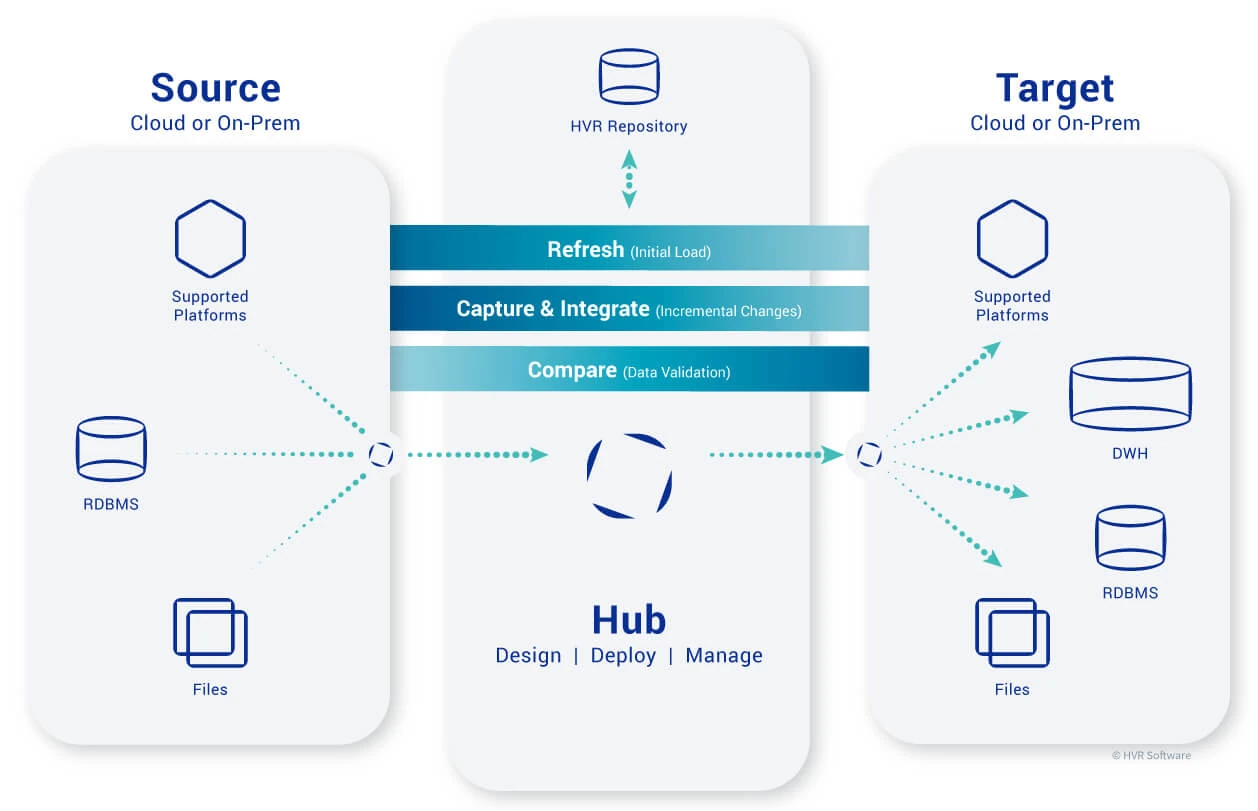
The following image shows a Channel scheme. It includes:
- Source Location Group. It can contain files, directories, data warehouses, or any of the locations for which DSS supports Capture. To see the list of all Locations that DSS supports as source, navigate to your preferred version of DSS in Supported Platforms.
- Actions, which take place in the DSS Hub.
- Target Location Group. It can contain files, directories, data warehouses, or any of the locations for which DSS supports Integrate. To see the list of all Locations that DSS supports as target, navigate to your preferred version of DSS in Supported Platforms (DSS supports all locations as target besides SAP NetWeaver).